

Cyber Monday often brings attractive discounts on engagement rings, but not every promotion offers the same value. Anyone comparing a Cyber Monday offer on a lab-grown pear-cut engagement ring will recognise the pressure these banners create. It's important to look beyond the advertised discount and consider factors such as diamond quality, certification, setting, and return policies. This lab-grown engagement ring buying guide explains what to check before making a purchase, helping you compare offers with confidence.
Quick summary
Before you check out, these five points matter most:
- Check the total price, including taxes and delivery, rather than the headline figure.
- Confirm in writing that the stone is lab-grown.
- Compare the pear cut’s carat weight alongside its measurements, not on carat weight alone.
- Read the return and resizing policy before the sale ends.
- Keep the certificate, receipt, and a copy of the listing.
Why Cyber Monday Is a Common Time for Ring Sales?
Cyber Monday falls on 30 November 2026, the Monday after Thanksgiving in the United States. It began as a US online shopping event, but many UK retailers now run their own promotions around the same date, often with different end times and exclusions. Jewellers use these windows to shift stock, respond to competitors and encourage buyers who have been comparing options for weeks.
That timing is useful for shoppers, but it also compresses decisions. A Cyber Monday engagement ring deal may be a real saving, a standard price with a new label, or a conditional offer that applies only to certain stones. Treat the sale as one factor among several, and give yourself time to check the details.
Lab-Grown Pear Cut Basics: Shape, Proportions, and Look
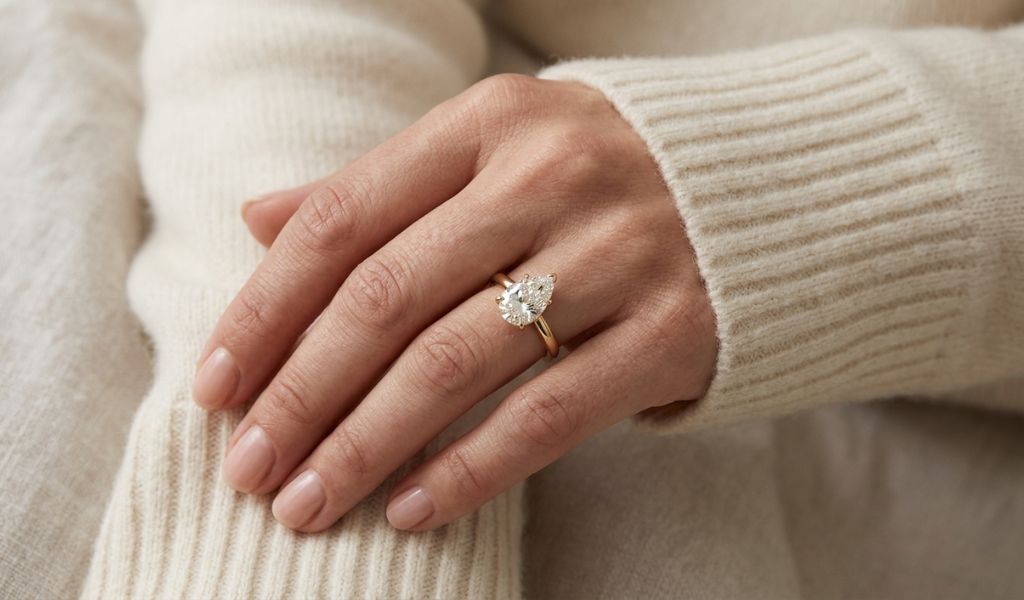
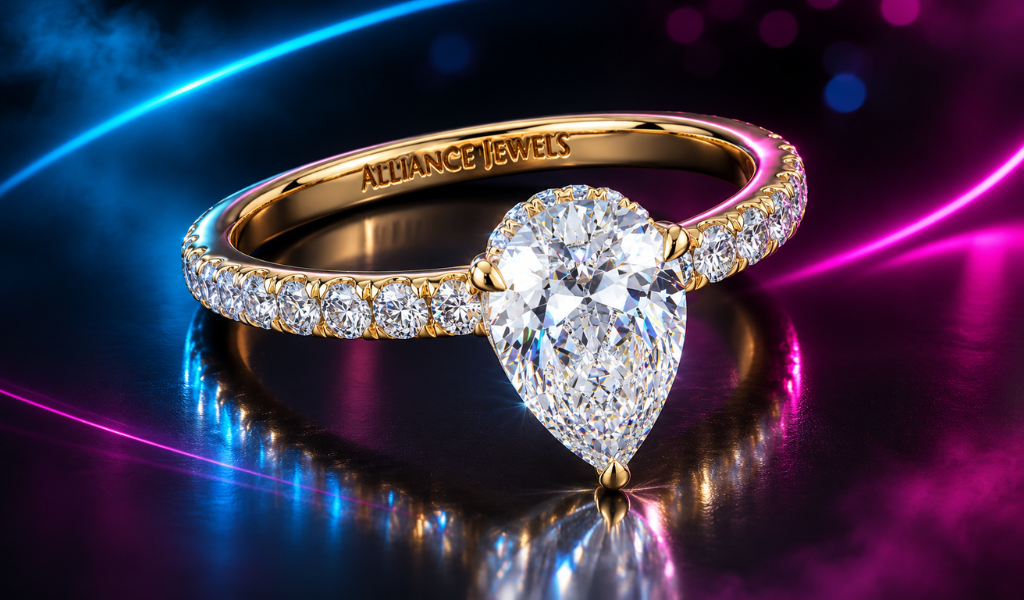
A pear shape engagement ring combines a rounded end with a pointed end, and it is often chosen for its elongated outline. Two stones with the same carat weight can look quite different on the hand, because the spread of the stone across the surface depends on its proportions.
Consider a 1.2 ct pear and a 1.0 ct pear with a longer, slimmer outline. The lighter stone may appear larger face-up because its shape covers more of the finger’s visible surface. Carat weight measures mass, not spread, so a ring that looks impressive in a photograph is not always the heavier stone. This is why listed measurements matter. Pear-cut stones also have a pointed tip that is more vulnerable to chipping than a rounded cut.
Lab-Grown or Natural: What the Choice Changes
A Lab-Grown diamond has the same chemical, physical, and optical properties as a mined diamond. The difference lies in origin, and that origin affects price and resale. A pear-cut lab-grown diamond is generally priced below a comparable natural stone, while its resale market is typically weaker. Clear labelling is important. A listing that uses the word “diamond” without saying “Lab-Grown” or “lab created” leaves the buyer to work out what they are paying for. Good retailers state the origin plainly in the product title, the specifications, and the certificate. If a listing is vague on this point, ask before you pay.
For buyers weighing Lab-Grown vs. natural stones, it helps to decide early which trade-off matters more: lower cost or long-term resale value. That answer will shape which offers are worth considering.

How to Judge a Sale Offer Before You Buy?
The table below sets out the checks that matter most and the warning signs to watch for.
|
|
|
|
|
|
|
|
|
|
|
|
|
|
|
|
|
|
|
|
|
|
|
|
|
|
|
|
|
|
|
|
|
|
|
Pay particular attention to the “original price” comparison. A crossed-out figure only tells you something useful if the retailer can show that the item was genuinely sold at that price.
Also read: How Much Does A Lab Grown Pear Cut Engagement Ring Typically Cost?
Protecting Your Purchase After the Sale
Sale pages change quickly, and a listing you saw on Monday may look different by Wednesday. Save a screenshot of the product details, the offer terms, and the returns policy before you check out. If the retailer later disputes what was promised, that record will matter.
Keep the grading certificate and the receipt together, and check the return window against the date you expect the ring to arrive, not the date you place the order. Ask whether resizing is included, how long it takes, and whether a fee applies.
Conclusion
A good Lab-Grown pear cut engagement ring Cyber Monday offer is one you can verify. The price, the stone’s origin, the certificate, and the return terms should all be clear before you pay, and none of them should depend on a countdown timer. Compare the certificate and return terms before you check out, and give yourself the time to read the small print. If the details hold up, the offer deserves your consideration.
FAQs on Lab Diamond Pear Cut Ring
Is a Lab-Grown pear cut stone a real diamond?
Yes. Lab-Grown stones have the same chemical structure, hardness, and optical properties as mined diamonds. The key difference is how they were formed, which is why reputable sellers state the origin clearly.
How can I tell if a holiday ring sale is genuine?
Check the original price comparison, the start and end dates, and any exclusions in the offer terms. A genuine sale will state these clearly and let you verify the figures before checkout.
Are pear cut rings harder to set than round ones?
The shape requires a setter to pay attention to the pointed tip and the alignment of the stone. A skilled jeweller can set a pear cut securely, and protective tip designs such as bezel or reinforced prongs help guard the point against knocks.
What should I check on a diamond certificate?
Look for the name of the grading laboratory, the stone's measurements, carat weight, colour, clarity and cut grade where applicable, and a report number you can verify on the lab's website.
Can I return a Lab-Grown ring if I change my mind?
It depends on the retailer. Some offer a fixed return window with a full or partial refund, while others allow only exchanges or store credit. Read the policy before you buy, and confirm it in writing if the terms are unclear.